Every day, online users face increasing threats to their digital privacy. Fortunately, Virtual Private Networks (VPNs) offer a solution to secure internet access. These tools protect users from hackers, prevent tracking, and stop unauthorized access to data. There are two main types of VPNs that address these security challenges: residential VPNs and traditional VPNs.
While both types achieve the same results, they operate through different techniques and provide distinct benefits to individuals.
In this blog post, we will explore the differences between residential VPNs and traditional VPN services.
Let’s get started!
Residential VPNs and Traditional VPN Services Defined
What are Residential VPNs
A Residential VPN routes internet traffic through IP addresses assigned to real residential users by their Internet Service Providers (ISPs). These IP addresses appear to belong to ordinary households.
What are Traditional VPN Services
A Traditional VPN (Virtual Private Network) creates a secure, encrypted tunnel between your device and a VPN server, masking your IP and encrypting your data.
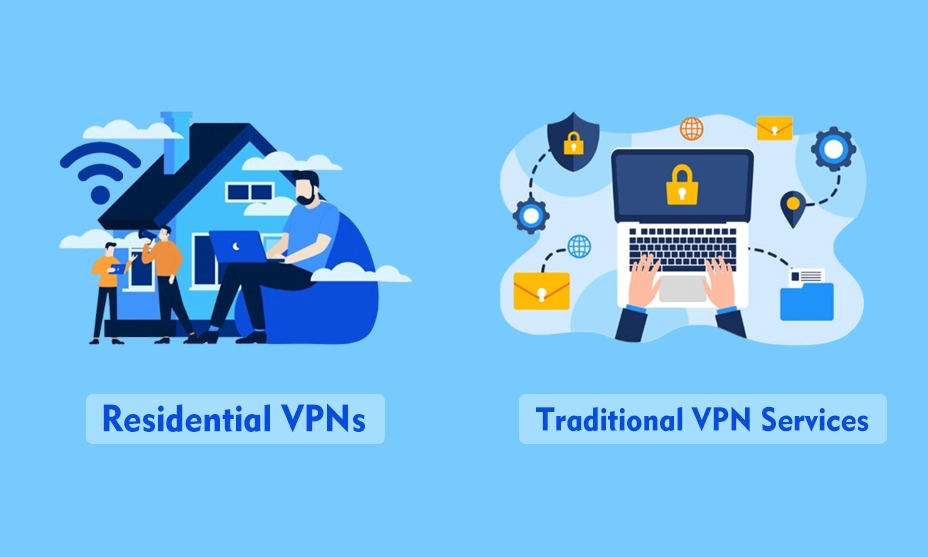
Learning How Residential VPNs Differ From Traditional VPNs
Choosing the right protection tool requires understanding how residential and traditional VPNs function differently. Here are the main differences that set these two VPN types apart.
1) Source of IP Address
The source of the IP address is the most significant difference between residential and traditional VPNs. Residential VPNs use IP addresses from actual residential connections, while traditional VPNs use data center addresses that websites can easily identify. As a result, residential VPNs are more effective at bypassing restrictions and accessing blocked content that data center traffic cannot reach.
2) Privacy and Anonymity
Residential VPNs offer superior privacy protection by connecting to websites through real home IP addresses that resemble typical internet users. Websites trust this traffic and do not block it. In contrast, traditional VPNs use data center addresses that websites can quickly recognize and block users.
3) Speed and Reliability
Traditional VPNs deliver faster internet speeds than residential options because they are powered by data center facilities that can handle large amounts of internet traffic efficiently. Residential VPNs, on the other hand, use individual household internet pathways, which may reduce performance but offer more reliable connections for prolonged use.
4) Common Use Cases
Residential VPNs are ideal for tasks requiring high anonymity, such as web scraping, marketing research, and SEO analysis. They help users appear as genuine visitors from various locations, facilitating the acquisition of data sets. Traditional VPNs are better suited for regular online security and privacy protection, allowing users to bypass geo-blocked content and browse the internet safely.
5) Cost
Residential VPNs are more expensive than traditional VPNs because they require managing groups of household IP addresses that are challenging to obtain and handle. In contrast, traditional VPNs use data center IPs that are cost-effective and easily accessible, making them suitable for basic individual usage.
6) Security and Encryption
Both residential and traditional VPN services offer strong security and encryption to protect user data. Residential VPNs enhance security through their detection-resistant nature, using authentic home IP addresses that blend naturally with regular internet activity. Traditional VPNs may struggle with platforms that have advanced detection measures but still provide robust security.
7) Impact on SEO and Marketing
Residential VPNs are extensively used by marketing professionals for location-based SEO research, enabling access to regional search results and market analysis. They can bypass detection measures that websites deploy against other privacy tools. Traditional VPNs may be quickly identified and blocked in these activities, making residential VPNs more suitable for gathering accurate local search information for global marketing strategies.
8) Connection Stability
Residential VPNs provide more stable connections than traditional alternatives by using static IP addresses connected to physical locations, reducing connection disruptions. Traditional VPNs may face performance issues when data center servers become overloaded with users, making residential VPNs preferable for tasks requiring consistent internet access.
9) Customer Support
Residential VPN companies offer specialized customer support services, crucial for businesses and professionals with specific requirements. Traditional VPNs provide basic customer support but may not address complex issues like IP rotation or heavy traffic management effectively.
Summing Up
Residential and traditional VPNs play essential roles in safeguarding online privacy. Residential VPNs are ideal for users seeking maximum anonymity and unrestricted access to geo-blocked content, as well as for specialized activities like digital marketing research. Traditional VPNs offer budget-friendly solutions for secure browsing, making them suitable for everyday users. Consider your specific requirements when choosing between them. For those prioritizing privacy and unlimited access, a residential IP VPN may be the ideal choice.